What You're Getting Wrong About Boundaries
A 4 Part series all about Boundaries!

When I first sat down to write this, I fully intended for it to be one neat little blog post, succinctly discussing the essentials of boundaries.
But, oh wow, did I have a lot to say about boundaries!
Trying to squeeze all that nuance into one post felt like trying to fit an elephant into a teacup. I don't think I can do this vital topic justice in a single sitting!
So, I'm excited to announce that I am breaking this topic into a four-part series! I'll be releasing a new post every week to help you dive into these concepts more deeply. (Except, the week of Christmas, because boundaries, am I right?! 😉)
Let's dive right into Part 1 and start uncovering what you might be getting wrong about boundaries!
Part 1 | Core Concepts
Boundaries.
The word itself can sometimes evoke a sense of rigidity, worries about confrontation, or even fears of “being too mean”. But what if I told you that most of what you think you know about boundaries is, well, wrong? Or at the very least, incomplete.
Boundaries are not about keeping people out; they're about creating a safe and sustainable space for yourself and for your relationships to grow, both personally and professionally.
Beyond the Basics: The 7 Types of Boundaries
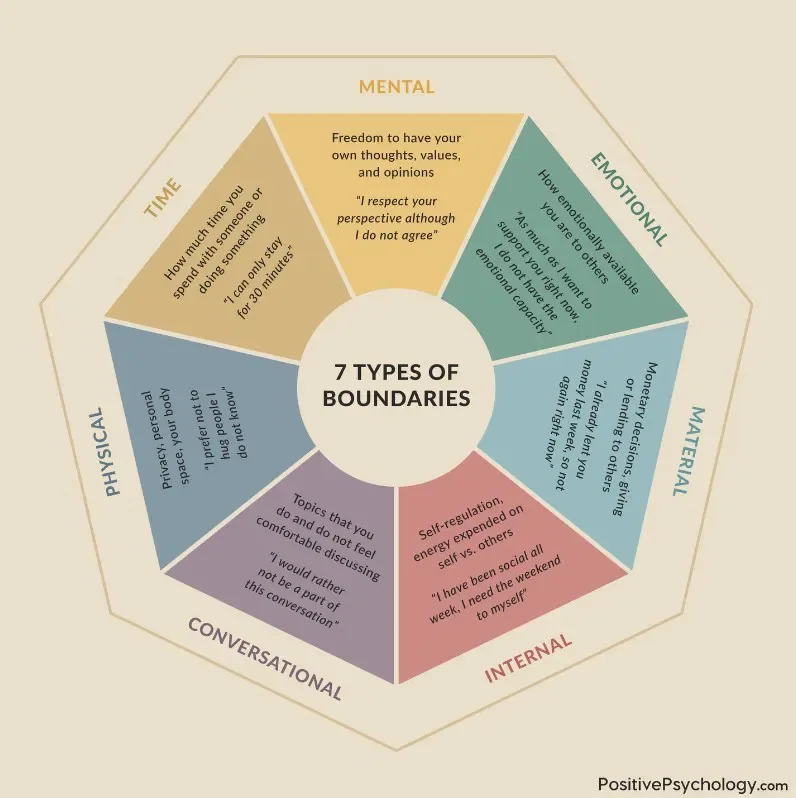
Did you know there are actually seven different types of boundaries?
Seven?!
Yes, seven!
Understanding these distinctions is the first step to truly mastering your personal and professional relationships.
7 Types Explained
1. Time Boundaries: These define how you allocate your time and attention.
Example: Declining to take on additional projects when your plate is already full, or setting specific hours when you respond to work emails.
For instance, an employee who consistently logs off at 5 PM, even when colleagues stay late, is maintaining a time boundary.
2. Mental Boundaries: These protect your thoughts, opinions, and beliefs. They involve respecting differing viewpoints without feeling obligated to change your own or debate endlessly.
Example: A manager frequently tries to impose their preferred solution before the team has finished analyzing the data. Your boundary may be asserting, "I appreciate your input, but I need to complete my own analysis before I commit to a solution." (This protects your mental process from being overridden.)
3. Emotional Boundaries: These relate to your feelings and how you manage emotional information from others. It's about not taking on others' emotions as your own or allowing them to dictate your emotional state.
Example: A manager listening empathetically to an employee's frustration about a difficult client, offering support, but not internalizing the employee's stress or allowing it to overwhelm their own workday.
(Pro tip: Practice asking yourself “Is this mine or theirs?” The more you can distinguish where your emotions begin and end the more easily you can refrain from taking other’s emotional weight on your own shoulders.)
(Practice: Imagine there’s a clear bubble around you. You can see people outside of the bubble, you can hear people outside of the bubble, but their emotions stop at your bubble barrier. This doesn’t mean that you can’t empathize or care about what they are feeling, it simply means that their anxiety is not your anxiety, their anger is not your anger, their frustration is not your frustration ect.)
(Note: Another, grosser, way to think about this: If someone was getting sick you may empathize with them and even want to help them but your going to hold their hair back and get them a glass of water, your not going to stand their letting them vomit into your hands 💁♀️.)
4. Material or Financial Boundaries: These define how you lend, share, or care for your possessions and resources.
Example: Politely declining a colleague's request to borrow your expensive noise-canceling headphones for an extended period, or setting clear expectations about returning borrowed items.
5. Internal or Intellectual Boundaries: These are boundaries you set with yourself. They involve self-discipline, self-care, and managing your own inner critic.
Example: Taking a “mandatory” lunch break away from your desk, even when deadlines loom, to prevent burnout.
Example: Before the start of the week, you review your task list and deliberately schedule only five major priorities, even if you could technically add two more. You hold the boundary that your maximum capacity is five to ensure high-quality output and avoid Friday burnout. (This protects your energy by setting realistic limits with yourself.)
(Confession Time: I am so tempted by this one when my motivation is high! It feels great to strike while the iron is hot and capitalize on that high productivity burst. But I've learned the hard way that pushing past that internal limit almost always leads to a major productivity slump, sometimes lasting a few days or even longer! Setting the boundary now is an investment in consistent output later.)
6. Conversational Boundaries: These dictate what topics you're comfortable discussing, how you communicate, and how much you share.
Example: A team member begins using highly cynical or negative language when discussing another department. Your boundary is to state your standard for communication: "I prefer to keep our conversations productive. Let's focus on solutions rather than complaining about [other departments]." (This protects the tone and focus of the discussion.)
7. Physical Boundaries: These relate to your personal space, touch, and physical comfort.
Example: Maintaining a comfortable distance during conversations, or politely declining an unwanted hug from a colleague in the office.
(Pro tip: Use the phrase, "I hope you understand" when you express a boundary to someone: EX: "Oh, I actually prefer not to be hugged at work, I hope you can understand.")
Alright, let’s wrap this up!
We've covered the seven fundamental boundary types. But here’s the thing: understanding the types is step one. Step two is figuring out the quality of your boundaries. Are they sturdy? Are they easily walked through?
If you've ever felt like your boundaries are either totally non-existent (hello, people-pleasing!) or so harsh they push everyone away, then this next post is for you.
In Part 2, we will discuss boundaries as a spectrum. We're exploring the four stops on this spectrum, from Non-Existent to the "Freaking Wall," so you can identify your current default and start building the healthy, firm boundaries that actually allow your relationships to thrive!
